Week 2: Math and art
Week 2: Math & Art
Scientists or mathematicians are involved with art becasue they too are often creative people that enjoy expressing them selves in a different an interesting way. Science, art, and math have a unique ability to bring out the creative natural in people all around the world. Juxtaposition with in science and art is a position in which two objects are place side by side allowing the objects to compare and contrast bringing more attention to the audiences eye. Within math, juxtaposition means to have side by side numbers which are multiplexed creating a new meaning. These two juxtapositions are alike in the sense that they both create a different and new end product overall. Therefore in the math problem or the art piece, the audience at the end, can develop a new meaning or understanding of the piece/problem.
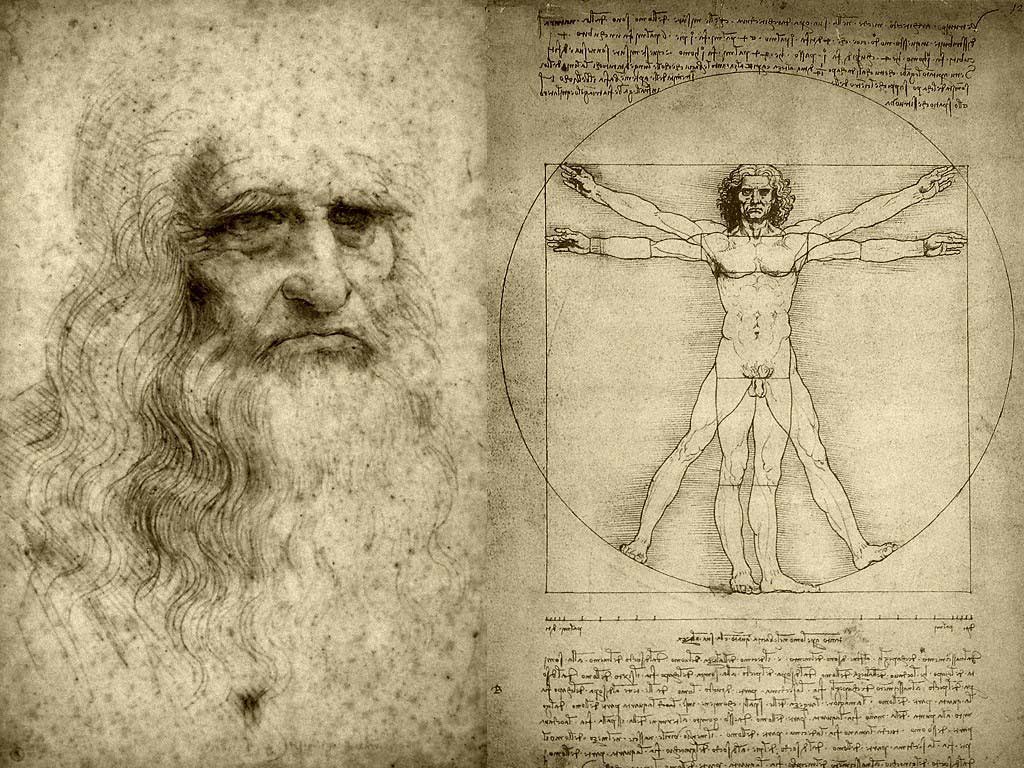
Leonardo Da Vinici was a artist from Tuscany Italy and used mathematics to create his artwork. He is well know for the picture demonstrated on the left. The man was name "Vitruvian Man." Leonardo was close the mathematician named Luca Pacioli. In the 15th century, it was very common for mathematicians to also be artist; most likely to be painters. Leonardo was a polymath who enjoyed painting, drawing, inventing, sculpting and mathematics.
I've learned that in the 15th and 16th century, it was very common for mathematicians to make a living from not only math but also painting and drawing. Math and and science in the past were looked at as a way to further design a system or painting. For example, drawing or sketching something out with the math or science only helps create a better outcome of the product. In today's world engineers do this for a living. They are constantly sketching things out using rulers and scientific ways and later creating an object that could be considered art. For example, a car needs to be sketched and measured and many more things and later it is transformed into a luxury.
I've learned that in the 15th and 16th century, it was very common for mathematicians to make a living from not only math but also painting and drawing. Math and and science in the past were looked at as a way to further design a system or painting. For example, drawing or sketching something out with the math or science only helps create a better outcome of the product. In today's world engineers do this for a living. They are constantly sketching things out using rulers and scientific ways and later creating an object that could be considered art. For example, a car needs to be sketched and measured and many more things and later it is transformed into a luxury.

References
“The Mathematical Art of M.C. Escher.” The Mathematical Art of M.C. Escher, Platonic Realms, 1997, platonicrealms.com/minitexts/Mathematical-Art-Of-M-C-Escher/.
Lang , Robert. “Robert J. Lang Origami .” Origami Master, Tason Web Works , 2004, langorigami.com/.
Lang , Robert. “Robert J. Lang Origami .” Origami Master, Tason Web Works , 2004, langorigami.com/.
Samyeargin, director. YouTube. YouTube, YouTube, 14 Sept. 2008, www.youtube.com/watch?v=N7b0cLn-wHU.
A Square. “Flatland.” Flatland, by E. A. Abbott, 1884, www.ibiblio.org/eldritch/eaa/FL.HTM.
Dunham, William: "The Mathematical Universe". John Wiley&Sons, 1994
“Leonardo Da Vinci.” Mathematicians - Leonardo Da Vinci, mathematica.ludibunda.ch/mathematicians6.html.
Dunham, William: "The Mathematical Universe". John Wiley&Sons, 1994
“Leonardo Da Vinci.” Mathematicians - Leonardo Da Vinci, mathematica.ludibunda.ch/mathematicians6.html.


Hi Veronica! It was really nice meeting you at the event this week! I really like that you used a definition of juxtaposition in your explaination. You also didn't just copy/paste it but put it into your own words to show your understanding. I also think that your comment about the increasing seperation between art and science since the time of people like DaVinci.
ReplyDelete